
News | January 2026
Updates and opportunities from our spinouts and pipeline
Welcome to our first Innovation Newsletter from Queen Mary University of London.
As 2026 gets going, all eyes will be on the economy. Every day at Queen Mary our researchers are developing new innovations in every growth area of Britain’s industrial strategy: life sciences, clean energy, advanced manufacturing, defence, digital and technologies, financial services, professional and business services, and the creative industries.
It’s a testament to the value of university-led innovation for our economy and society, and a massive opportunity for us all to make a meaningful impact, whether as inventors, investors, or industry partners.
From natural appetite control to AI-powered diagnosis, read on to discover the latest opportunities from our incredible spinouts, industry collaboration, and pipeline.
Dr Phil Clare, CEO, Queen Mary Innovation
Latest from our spinouts
Elcella prepare for next consumer trial. Elcella Limited helps people manage their weight by unlocking the body’s own appetite regulating hormones – unlike the weight loss drugs which rely on synthetic hormones. It’s the first product to be scientifically proven to do so, and it’s built on a decade of Queen Mary research by founders Dr Madusha Peiris and Dr Rubina Aktar. They’re growing fast and expanding into Europe and North America.
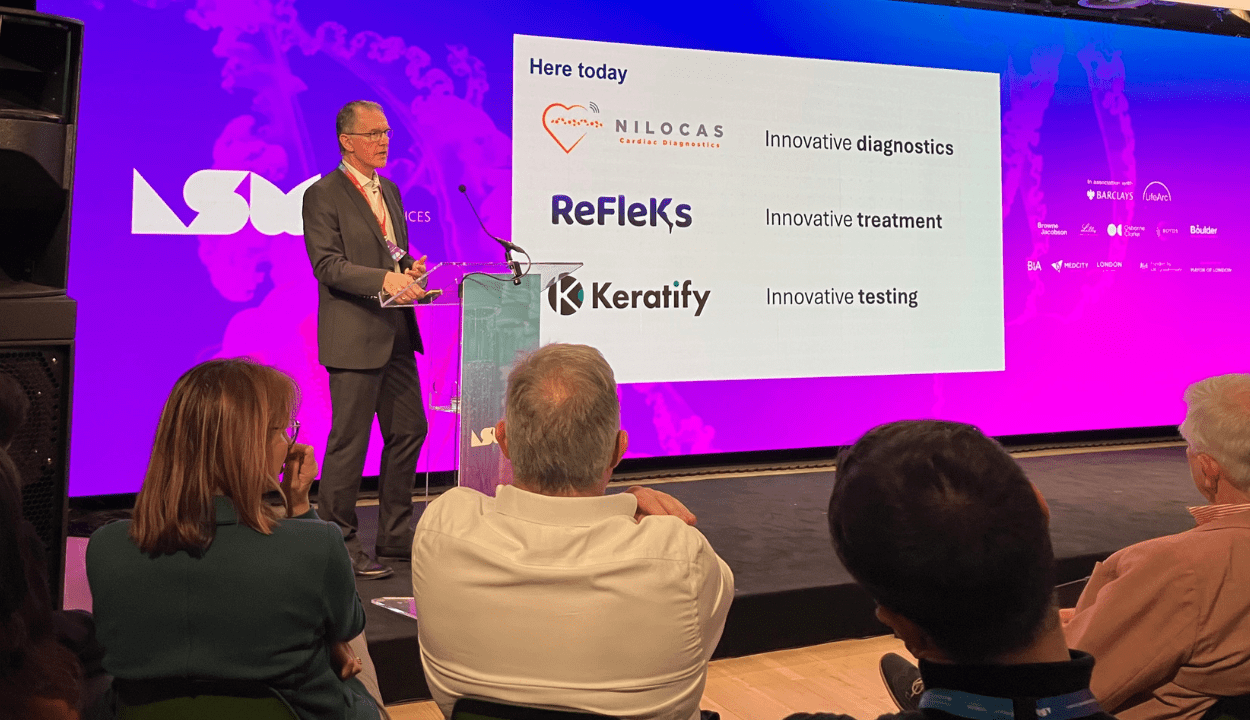
Dr Suzanne Eldridge wins Life Sciences Emerging Entrepreneur of the Year at the OBN Awards. Together with Prof Francesco Dell’Accio , Dr Suzanne Eldridge created ReFleks, a novel way of fixing joint damage to prevent future osteoarthritis which excels in all the areas where the current method falls short: it doesn’t require open surgery, so is easier to administer; it’s significantly cheaper than surgery, making it affordable for health services; and it can be done quickly with fewer complications.
Chatterbox Labs exits to Red Hat. A pioneer in AI safety, Chatterbox provides a robust, model-agnostic approach to validating data and large language models. By joining Red Hat, the world’s leading provider of open-source solutions, Chatterbox can bring its validated, independent safety metrics to the open-source community, so we can all benefit from AI that is secure, scalable and open. Chatterbox was created in Queen Mary School of Electronic Engineering and Computer Science.
Nilocas AI appoint Athar Ali as CEO. Athar Ali is a globally experienced healthcare executive who has launched industry‑leading medical devices for spinouts from Oxford University and the National Physical Laboratory as well as high‑growth startups and new business units within pharma, scaling them to multimillion revenues. Nilocas AI is developing a non‑invasive chest patch the size of a credit card to screen coronary artery disease earlier and more efficiently. Coronary artery disease kills 9 million people each year, the world’s leading cause of death.
LANDR acquires Reason Studios. The deal enables the bringing together of LANDR’s AI-powered music mastering tools with Reason Studios’ digital audio workstation. LANDR was born out of research in Prof Josh Reiss’s lab and has gone on to become a market leader used by 7 million musicians worldwide.
Partner with Queen Mary
RipenAI launches pilot programme. Prof Lei Su and Dr Xuechun Wang have invented a portable optical sensor which uses machine learning to give winemakers instant, accurate ripeness data, removing the need for manual sampling and slow destructive testing. The team are looking for innovative vineyards, agritech partners, and fruit orchards to help test the prototype and shape the future of smart harvesting.
Clinicians seek to reshape the traumatic shock survival window. Prof Karim Brohi and Colonel Nigel Tai are building a consortium to create a new class of survival therapeutics and diagnostics which could reshape civilian, combat, and mass-casualty care, saving thousands of lives every year.
Learn more about this opportunity
Creating the next generation of wearable health sensing. Prof Greg Slabaugh is building a cross-disciplinary team of researchers and clinicians to develop wearable technologies that go beyond heart rate and step counts. The TACTIS programme reaches beneath the skin to measure the body’s chemistry alongside vital signs, giving patients and clinicians a richer, real-time picture of health than current consumer wearables.
Connect with Dr Joanne Chamberlain to explore the possibilities for industry involvement.
Cleaning the air with AI. Dr Mona Jaber leads a multidisciplinary team developing digital twins of individuals and neighbourhoods to model how policy interventions in air quality and transport can improve population health across the lifespan. This technology aims to enable scalable health monitoring, virtual trials for preventive healthcare, and the design of healthy, equitable neighbourhoods with cleaner air and more sustainable environments.
Connect with Dr Joanne Chamberlain to explore the possibilities for industry involvement.
Highlights from our pipeline
Licensing opportunity for FluoRight. Invented by Prof Mangala Patel, FluoRight coats your teeth with a layered double hydroxide, held in place with a polymer, which slowly releases fluoride and calcium ions over a twelve-hour period. In doing so, FluoRight equips your mouth to continually cleanse itself throughout the day or night. We’re looking to partner with dental companies to add FluoRight into toothpastes and mouth washes.
Clinical trial underway for rheumatoid arthritis therapy predictor. Prof Costantino Pitzalis and Prof Myles Lewis have invented a way to predict patient response to rheumatoid arthritis biological therapies so that doctors can select the best treatment for the individual patient. With a clinical trial underway, the team are on course to be the first to introduce a predictive test into a real-world medical setting. We are looking for commercial partners to help develop the approach for clinical use.
Learn more about this opportunity
Startup stories from our students and alumni
The Washing Machine Project among 2025s best inventions. Queen Mary alumnus and honorary doctor, Dr Navjot Sawhney featured in TIME Magazine’s Best Inventions of 2025 list for social impact. 5 billion people worldwide wash their family’s clothes by hand. The Divya washing machine is 75% faster, uses 50% less water, and requires zero electricity.
Learn more about The Washing Machine Project